
Round vs. Rectangle: What’s the Best Dining Table for Your Space?
Choosing a dining table seems simple — until you start shopping.
Suddenly you’re asking bigger questions. How many people do we really seat? How much space do we need to walk around it? Why does one shape feel warm and inviting while another feels formal and structured?
The shape of your dining table is not just a design decision. It affects traffic flow, comfort, conversation, and how often your family actually uses the space.
Before you invest in a new table — especially a solid wood piece built to last decades — it’s worth thinking strategically. Let’s break down the differences between round and rectangular tables so you can choose the one that truly fits your home.
Why Table Shape Matters More Than You Think
A dining table is the anchor of the room. Everything else — chairs, lighting, sideboards, rugs — revolves around it.
But beyond style, shape determines:
-
How easily people move through the space
-
How many guests you can comfortably seat
-
Whether conversation feels intimate or stretched
-
How well the table fits the architecture of the room
Too many homeowners buy based on appearance alone. The smarter approach is to consider function first, then aesthetics.
When you do that, the right shape becomes much clearer.
The Case for Round Dining Tables
Round tables naturally create intimacy. There are no “head” seats, and everyone faces one another equally. This makes them ideal for conversation and connection.
If your goal is a dining space that feels warm, relaxed, and inclusive, round tables deliver that effortlessly.
Round Tables Work Best When:
-
Your dining area is square rather than long and narrow
-
You regularly seat four to six people
-
You want better flow in a smaller space
-
You prefer a softer, less formal aesthetic
Because there are no sharp corners, round tables improve traffic flow. In tighter rooms, this matters. You’re less likely to bump into edges, and the room feels less crowded.
Pedestal bases, which are common in round tables, also allow flexible chair placement. Without table legs at the corners, you can adjust seating more easily.
However, round tables do have limits. Once you move beyond six people, they require a much larger diameter. At that point, conversation can become strained because guests are seated farther apart.
If you frequently host larger gatherings, this is where you need to think carefully.
The Strength of Rectangular Dining Tables
Rectangular tables are classic for a reason. They maximize seating capacity and work exceptionally well in longer rooms.
If your dining room is narrow or elongated, a rectangular table will visually align with the architecture. It creates balance instead of fighting the room’s proportions.
Rectangular tables are especially effective when:
-
You host larger dinners regularly
-
Your room is longer than it is wide
-
You want a more formal or structured look
-
You need expandable options for holidays
Expandable rectangular tables with leaves offer tremendous flexibility. For everyday use, you keep the table compact. For holidays or celebrations, you extend it.
There is a reason this shape has endured for centuries. It simply works — especially for families who entertain often.
The tradeoff? Rectangular tables can feel more formal. And in smaller spaces, they may restrict traffic flow if not sized carefully.
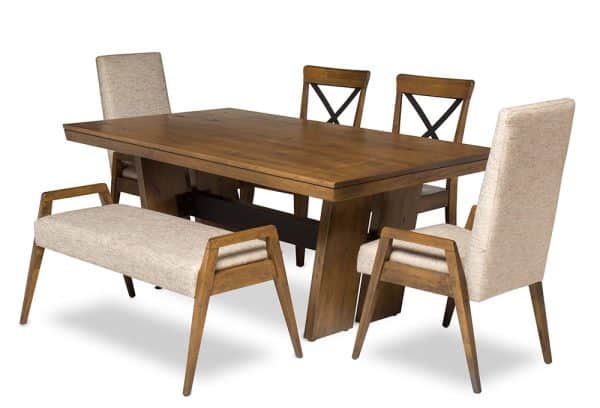
Even with different types of seating, this Veti Dining Set looks well put together.
Conversation: Intimate vs. Structured
Here’s something many shoppers overlook: table shape subtly influences social dynamics.
Round tables encourage equal participation. There is no defined “end.” Everyone can see and hear one another easily.
Rectangular tables introduce hierarchy. There are head seats. There are sides. In larger groups, guests may need to lean forward or speak louder to connect across the length.
Neither is right or wrong. It depends on how you use your space.
If weeknight dinners are about family closeness, a round table may serve you beautifully. If you host formal dinners or large holiday meals, a rectangular table provides organization and structure.
Be honest about your lifestyle. Don’t design for a fantasy. Design for how you actually live.
Traffic Flow and Spacing: The Practical Side
No matter which shape you choose, spacing matters.
Ideally, you want at least 36 inches between the edge of your table and any wall or large piece of furniture. This allows guests to pull out chairs and move comfortably behind seated diners.
In tighter areas, round tables often feel more forgiving because movement happens in curves instead of straight lines. In larger rooms, rectangular tables can define the space more clearly.
If your dining area connects to a kitchen island or bar seating, think about visual continuity. A rectangular dining table paired with rectangular bar stools creates clean lines. A round table can soften a space filled with straight edges.
This is where thoughtful planning pays off.
Oval Tables: The Hybrid Option
If you’re torn between shapes, consider oval.
Oval tables offer the linear seating benefits of rectangular tables while softening corners like a round table. They’re especially useful in rooms where you need length but want to avoid sharp edges.
Oval tables are ideal when:
-
You want better traffic flow than a rectangle offers
-
You need more seating than a round table provides
-
You prefer a transitional style
This shape often feels less formal than a rectangle but more structured than a circle.
For families who entertain moderately — not massive holiday gatherings, but regular friends and family dinners — oval can strike the right balance.
Expandability: Planning for Real Life
One of the smartest investments you can make is in an expandable solid wood table.
Life changes. Families grow. Friends gather. Holidays happen.
Rectangular tables commonly accommodate leaves, but round tables can as well — either expanding into ovals or increasing in diameter.
Before you purchase, ask:
-
How many people do we seat weekly?
-
What’s our maximum seating need?
-
Do we host major holidays?
-
Will this table serve us five, ten, or twenty years from now?
A well-built solid wood expandable table is not just furniture. It’s long-term planning.
Style and Architectural Alignment
The architecture of your home should guide your decision.
In open-concept layouts, rectangular tables often mirror kitchen islands and cabinetry lines. This creates visual cohesion.
In smaller breakfast nooks or dedicated dining rooms with square dimensions, round tables feel intentional and balanced.
Also consider ceiling height and lighting. A long rectangular table pairs naturally with linear chandeliers. A round table centers beautifully under a circular pendant.
When the lines of the table align with the room, the space feels calm and grounded.
Material Matters as Much as Shape
Regardless of shape, prioritize construction.
Solid wood tables offer durability, refinishing potential, and longevity that veneer or composite materials cannot match. Especially for families, a dining table should withstand years of use.
Scratches can be repaired. Finishes can be refreshed. Styles can evolve.
Cheap tables often look fine on the showroom floor but deteriorate quickly under real-life use.
If you’re going to invest, invest once.
How to Decide: A Simple Framework
If you’re stuck, walk through this quick filter:
-
Measure your room carefully and note its proportions
-
Identify your typical seating needs versus maximum needs
-
Evaluate your traffic flow and surrounding furniture
-
Be honest about whether your gatherings are intimate or large
Function first. Then aesthetics.
The right shape will not only look good — it will feel right when you sit down.
The Bottom Line
There is no universal “best” dining table shape. There is only the one that fits your space, your habits, and your long-term needs.
Round tables foster closeness and improve flow in smaller areas. Rectangular tables maximize seating and align beautifully with longer rooms. Oval tables offer a flexible middle ground.
Choose intentionally. Invest in quality. Think beyond today and consider how you’ll use the table five years from now.
When you select the right shape — crafted in solid wood and built to last — you’re not just buying a table.
You’re choosing the setting for years of meals, conversations, and celebrations to come.