
The Eat-In Kitchen Is Back: Creating a Comfortable Everyday Gathering Space
For years, kitchen design seemed to be moving in one direction: bigger islands, larger open-concept spaces, and increasingly formal kitchens that sometimes looked more like showrooms than places where families actually lived.
But the eat-in kitchen never really disappeared. In fact, it is becoming increasingly relevant as homeowners rethink how they use their homes. Families want spaces that feel comfortable, welcoming, and useful throughout the day—not just when dinner is served.
The modern eat-in kitchen may include a traditional breakfast table, a banquette tucked into a corner, counter stools around an island, or a combination of several seating areas. What matters is not the specific configuration. It is the idea that the kitchen should provide comfortable places to sit, gather, eat, work, talk, and simply spend time together.
For busy households, that makes the eat-in kitchen one of the hardest-working rooms in the home.
The Kitchen Has Become More Than a Place to Cook
Think about everything that happens in the average kitchen during a typical day.
Someone pours a cup of coffee before work. Children eat breakfast before school. A laptop appears on the counter while someone checks email. Groceries are unloaded. Homework gets spread across the table. Friends stop by and naturally gravitate toward the kitchen. Dinner is prepared while someone else sits nearby and talks about the day.
Even when a home has a formal dining room, much of everyday life happens somewhere else.
That is one reason comfortable kitchen seating matters. If your kitchen is where people naturally gather, the furniture should support the way you actually live rather than the way a room is theoretically supposed to function.
The Return of the Kitchen Table
The traditional kitchen table offers something even the largest island cannot completely duplicate: a comfortable place where everyone can sit facing one another.
A kitchen table doesn’t need to be large. In fact, a smaller round or rectangular table can be ideal for breakfast areas and kitchen corners.
Round tables are especially useful when space is limited because they eliminate sharp corners and can make it easier to move through the room. Rectangular tables can work well against walls, beside windows, or in longer kitchen spaces.
The important question is scale.
A table that overwhelms the room will make the kitchen feel crowded, while one that is too small may not provide enough useful seating. Before buying, measure the space and consider not only the dimensions of the table but also the room required to pull chairs out comfortably.
Counter Stools Create Everyday Seating
For many contemporary kitchens, the island has become the modern equivalent of the breakfast table.
That makes choosing the right counter stools especially important.
Kitchen island seating may be used far more frequently than homeowners expect. What initially seems like a convenient place for a quick cup of coffee may become the preferred spot for breakfast, homework, casual dinners, or conversations while someone prepares food.
Comfort should therefore be considered alongside appearance.
A backless stool can create a clean, streamlined look and can often slide completely beneath the counter. However, stools with backs may be preferable when people regularly sit at the island for longer periods.
Swivel stools can also be useful in social kitchens because they allow people to turn toward different parts of the room without repeatedly moving the stool itself.
And don’t forget height. Counter-height and bar-height stools are not interchangeable. Measuring before purchasing can prevent one of the most common furniture-buying mistakes.
Make Room for Real Life
Beautiful kitchens frequently appear perfectly arranged in photographs. Real kitchens rarely stay that way.
There are backpacks, grocery bags, laptops, water bottles, mail, coffee mugs, sports schedules, school papers, and everything else associated with daily life.
Furniture for an eat-in kitchen should be chosen with that reality in mind.
Families with children may want durable finishes and upholstery that can withstand frequent use. Easy-to-clean materials can make everyday maintenance simpler. A heavily used kitchen chair should feel substantial enough to tolerate being pulled in and out repeatedly.
Durability becomes particularly important because kitchen furniture often receives considerably more use than formal dining furniture.
A dining room chair might be used several times a week. A favorite kitchen stool might be used several times before noon.
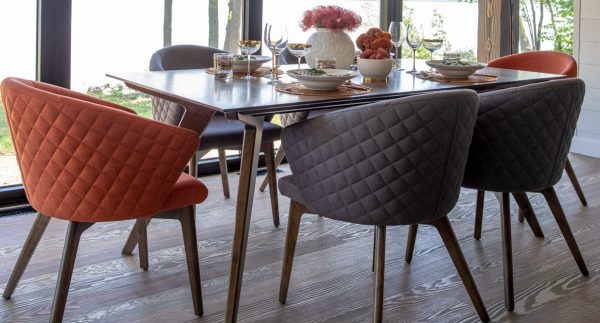
These dining chairs from the Noah dining set offer plenty of support and comfort with padded seats and armrests.
Create Conversation, Not Just Seating
Furniture placement can influence how people interact.
If every seat faces the same direction, people may naturally focus on whatever is in front of them. Seating arranged around a table encourages face-to-face conversation.
A kitchen with both island seating and a table provides flexibility. Someone can sit at the counter and chat with the person cooking, while the table offers a natural place for family meals, games, homework, or longer conversations.
The goal isn’t necessarily to fit as many seats as possible into the kitchen. It is to create enough comfortable seating that people want to stay.
That distinction matters.
A beautiful stool that becomes uncomfortable after ten minutes may look wonderful but won’t necessarily turn your kitchen into a gathering place. A comfortable chair or stool invites people to settle in.
Don’t Be Afraid to Mix Seating Styles
An eat-in kitchen doesn’t require perfectly matching furniture.
In fact, coordinating different seating styles can make the room feel more collected and personal.
Kitchen chairs might feature wood frames while nearby counter stools incorporate metal. Upholstered chairs can soften a room dominated by hard surfaces such as countertops, cabinets, and appliances.
The key is finding some element that connects the pieces.
That connection might be color, finish, upholstery, shape, or overall design style. Furniture can coordinate without being identical.
This approach also allows homeowners to choose the seating that works best for each area rather than forcing one furniture style to solve every problem.
Think About Traffic Flow
Before adding a table or additional seating, consider how people move through the kitchen.
Major pathways between the refrigerator, sink, stove, pantry, and adjacent rooms should remain easy to navigate. Chairs and stools shouldn’t create an obstacle course when they’re occupied.
This becomes especially important around islands.
A stool may tuck neatly beneath the counter when no one is using it, but when someone sits down, both the stool and the person extend farther into the room. Make sure there is enough clearance behind occupied stools for other people to pass comfortably.
The same principle applies to kitchen tables. Measure the room with the chairs pulled out, not just pushed beneath the table.
A few inches can make the difference between a comfortable dining area and one that constantly feels cramped.
Design for the Way Your Family Lives
There is no universal formula for the perfect eat-in kitchen.
A household with young children may prioritize washable surfaces and sturdy chairs. Someone who frequently works from home may want supportive seating suitable for longer periods. Homeowners who entertain regularly may want extra stools that allow guests to gather around the kitchen island.
Start by paying attention to where people already congregate.
If everyone naturally ends up around the island, make that seating as comfortable as possible. If the kitchen table is constantly covered with homework and projects, choose furniture that can handle daily use. If guests always pull chairs into the kitchen while dinner is being prepared, consider whether additional permanent seating would make the room work better.
Good design often begins with observation rather than trends.
A Kitchen That Invites People to Stay
The renewed appeal of the eat-in kitchen reflects something larger happening in home design. People increasingly want rooms that support everyday life.
A kitchen doesn’t need to be enormous or perfectly styled to become the heart of a home. It needs to work.
The right table, dining chairs, and counter stools can transform unused square footage into a breakfast spot, homework station, casual dining area, conversation space, and gathering place.
And perhaps that is why the eat-in kitchen continues to endure.
Some rooms are designed to impress people when they arrive.
The best kitchens make them want to stay.