
The Best Dining Table Shapes for Every Home: Round, Rectangle, Square, or Oval?
A dining table is more than just another piece of furniture. It’s where families gather for weeknight dinners, children spread out homework, friends linger over coffee, and holiday traditions are created year after year. Choosing the right dining table can make your dining room feel comfortable, functional, and beautifully balanced.
While finish, material, and style are important considerations, one decision often has the greatest impact on how well a table fits your home: its shape.
Round, rectangular, square, and oval tables each offer unique advantages. The best choice depends on your room size, the number of people you typically seat, and how you use the space on a daily basis.
If you’re shopping for a new dining table, here’s what you should know before making your decision.
Why Table Shape Matters
Many homeowners begin their search by focusing on appearance. While aesthetics certainly matter, the shape of your table affects much more than style.
It influences:
- How easily people can move around the room
- How many guests can comfortably be seated
- The flow of conversation during meals
- Whether the room feels spacious or crowded
- How adaptable the table is for entertaining
Selecting the right shape helps create a dining space that works just as well on ordinary weeknights as it does during holiday celebrations.
Round Dining Tables: Perfect for Conversation
Round dining tables have long been associated with warmth and intimacy. Because everyone sits an equal distance from one another, conversation flows naturally across the table.
Unlike rectangular tables, there is no obvious “head” of the table, creating a more relaxed and inclusive atmosphere.
Best For
- Small dining rooms
- Breakfast nooks
- Apartments and condominiums
- Families of two to four
- Casual entertaining
Round tables also make excellent use of compact spaces because they eliminate sharp corners.
This creates smoother traffic flow, especially in rooms where people frequently walk around the dining area.
Things to Consider
As the diameter increases, reaching dishes placed in the center becomes more difficult.
Very large round tables often require a rotating lazy Susan to keep serving convenient.
If you regularly host eight or more people, another shape may provide more comfortable seating.
Rectangular Dining Tables: The Classic Choice
Rectangular tables remain the most popular dining table shape—and for good reason.
Their proportions naturally fit the shape of most dining rooms, allowing homeowners to maximize seating while maintaining comfortable walkways.
Whether your décor is modern, farmhouse, transitional, or traditional, rectangular tables offer exceptional versatility.
Best For
- Medium and large dining rooms
- Families of four or more
- Formal dining spaces
- Frequent entertaining
One of the biggest advantages is flexibility.
A six-person table can often expand to accommodate eight or even ten guests with extension leaves, making it an excellent long-term investment.
Things to Consider
Because rectangular tables have defined ends, the people seated at each end naturally become focal points during meals.
In larger gatherings, conversations often develop in smaller groups rather than involving the entire table.
This isn’t necessarily a drawback—it simply creates a different dining experience than a round table.
Square Dining Tables: Balanced and Contemporary
Square dining tables have become increasingly popular in modern homes.
Their symmetrical design creates visual balance while encouraging conversation among everyone seated.
For smaller families, square tables provide an inviting, intimate dining experience.
Best For
- Square dining rooms
- Couples
- Families of four
- Contemporary homes
Square tables also work well in open-concept floor plans where symmetry helps define the dining area without overwhelming the surrounding space.
Things to Consider
As seating capacity increases, square tables become significantly larger.
A square table designed for eight people occupies considerably more floor space than many homeowners anticipate.
If your household frequently entertains larger groups, a rectangular or oval table may prove more practical.
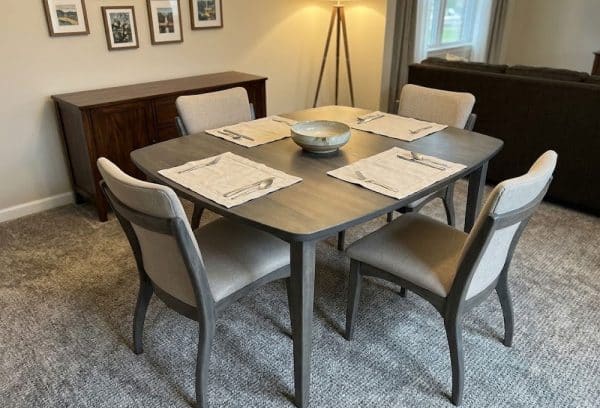
Oval Dining Tables: Elegant and Versatile
Oval tables combine many of the best characteristics of both round and rectangular designs.
They offer generous seating while softening the appearance of the room with graceful curved edges.
Because they lack sharp corners, oval tables often make narrow dining rooms feel more open.
Best For
- Long, narrow dining rooms
- Families that entertain
- Traditional and transitional homes
- Homes seeking softer visual lines
Many extension tables feature an oval shape once the leaves are installed, making them especially versatile.
Things to Consider
Oval tables typically require a bit more room than similarly sized rectangular models because of their curved profile.
However, many homeowners feel the softer appearance is well worth the additional space.
Matching Table Shape to Your Room
One helpful guideline is to let the room itself influence your decision.
Generally speaking:
- Long rectangular rooms pair naturally with rectangular or oval tables.
- Square rooms often look best with square or round tables.
- Smaller dining spaces benefit from round tables because they improve traffic flow.
- Larger rooms can comfortably accommodate rectangular extension tables designed for entertaining.
Leave approximately 36 inches between the edge of the table and nearby walls or furniture whenever possible. This allows guests to comfortably pull out chairs and move around the room.
Consider Your Entertaining Style
Think honestly about how you use your dining room.
Do you host large holiday dinners several times each year?
Do you regularly invite neighbors or extended family for meals?
Or is the dining room primarily used by your immediate household?
If your guest list changes throughout the year, an extension table deserves serious consideration.
Many modern extension mechanisms are remarkably easy to operate, allowing one person to expand the table in just a few minutes.
When not entertaining, the table remains compact enough for everyday living.
Don’t Forget the Chairs
The shape of your dining table also affects seating comfort.
Round tables typically allow chairs to be spaced evenly around the perimeter.
Rectangular tables often accommodate armchairs at each end while using side chairs along the sides.
Square tables usually look best with four matching chairs, creating a balanced appearance.
Whatever style you choose, make sure each diner has adequate elbow room. Approximately 24 inches of table width per person generally provides comfortable seating.
Materials Matter Too
Once you’ve selected the ideal shape, consider which material best suits your lifestyle.
Solid wood remains one of the most popular choices because of its durability, timeless beauty, and ability to develop character over time.
Glass tabletops create an open, airy appearance and can make smaller rooms feel larger by allowing light to pass through the space.
Stone and ceramic surfaces provide exceptional durability while offering a sophisticated, contemporary aesthetic.
Your dining table should complement the rest of your home’s furnishings while also standing up to your family’s everyday routines.
Think About the Future
A dining table is one of the most enduring pieces of furniture you’ll own.
Children grow.
Families expand.
Friends become regular dinner guests.
Holiday traditions evolve.
Choosing a table that can adapt to those changes helps ensure you’ll enjoy it for many years.
Extension tables, durable construction, and timeless designs often provide the greatest long-term value.
Rather than selecting a table that only meets today’s needs, consider how your household may look five or ten years from now.
Final Thoughts
There is no universally “best” dining table shape—only the one that best fits your home and lifestyle.
Round tables encourage conversation and make small spaces feel welcoming. Rectangular tables maximize seating and remain the classic choice for larger dining rooms. Square tables offer symmetry and intimacy, while oval tables combine generous seating with elegant, flowing lines.
By considering your room dimensions, entertaining habits, family size, and overall design style, you can confidently select a table that serves as the centerpiece of your home for years to come.
The right dining table doesn’t simply fill a room—it creates a place where people gather, stories are shared, celebrations unfold, and everyday meals become cherished memories.